
Keyword cannibalization is when two or more pages within your site compete with each other to rank in search results for the same or very similar keyword phrase.

What is keyword cannibalization and why is it one of the hidden SEO mistakes?
How does keyword cannibalization negatively affect your site's SEO?
Step 1: How to diagnose cannibalization using Google Search Console?
Remediation strategies: A discussion of 5 effective methods to combat cannibalization
How to plan a content strategy to avoid cannibalization in the future?
What are the benefits of SEO without cannibalization? Key benefits for business
What is keyword cannibalization and why is it one of the hidden SEO mistakes?
Keyword cannibalization is when two or more pages within your site compete with each other to rank in search results for the same or very similar keyword phrase. Instead of building one strong authority for a given query, you unknowingly distract from ranking signals, forcing Google to choose which of your pages is more relevant. This is one of the most common, and most insidious, SEO mistakesxbecause it stems from good intentions - the desire to cover your important topic as fully as possible. Unfortunately, in practice, this leads to a weakening of the visibility of both competing URLs.
What is keyword cannibalization and how does it affect my SEO?
In the simplest terms, cannibalization is the internal competition you create for yourself. Imagine you have two blog articles: one about "best shoes for running on asphalt" and the other about "shoes for running on hard surfaces." To a search engine, the intent of both topics is almost identical. As a result, Google may alternate displaying both pages at lower positions, instead of promoting one, stronger page at a high position. The impact on SEO is devastating because you dilute topic authority, split potential backlinks in half, and lower the overall strength of ranking signals directed to your domain for that particular phrase.
Why is keyword cannibalization called the "silent killer" of SEO?
The term "silent killer" is apt, as the problem often develops unnoticed, especially on expansive sites with lots of content. You create more articles, optimize them and enjoy the growing number of publications, not realizing that each new, thematically similar content can undercut the branch on which the existing ones are sitting. The symptoms are not immediate. Instead of a steep decline, you're seeing stagnation, unstable positions or ranking on the wrong sub-page that you think is most important. It's a slow process of eroding your visibility that, without proactive diagnosis, can sabotage your content marketing and SEO efforts for months.
What are the most common causes of keyword cannibalization?
The problem of cannibalization most often stems from the lack of a central content strategy and keyword mapping. When content creation is an ad hoc process, it's easy to forget that a similar topic has already been covered. Another common cause is poor optimization of existing pages. Instead of updating and expanding an old article, you create a new one, hoping for better results. Incorrect site architecture, where category, tag and product pages are optimized for the same phrases, also leads to cannibalization. In online stores, product pages with very similar goods whose descriptions are not differentiated enough for the search engine to distinguish them are also sometimes a problem.
How does keyword cannibalization negatively affect your site's SEO?
The negative effects of cannibalization go far beyond unstable positions. The problem strikes at fundamental aspects of optimization, weakening your site's authority, confounding search engine algorithms and degrading user experience. What affects a site's positioning is complex, and cannibalization destabilizes many key factors simultaneously, from on-page signals to behavioral metrics. Understanding these mechanisms is key to appreciating the severity of the problem and the motivation to solve it.
How does keyword cannibalization affect ranking on search engines like Google?
The main negative effect is a lowering and instability of rankings. When Google sees two pages from your domain responding to the same query, it has trouble clearly determining which is "the right one." As a result, it may alternately display both pages, but at lower positions than a single, consolidated and strong subpage would achieve. The algorithm may also mistakenly consider the weaker, less-optimized page as more relevant, leading to the ranking of the suboptimal URL. Instead of climbing to the top of the results, your pages "dance" in the rankings, often off the first page, losing valuable organic traffic.
Why is keyword cannibalization hurting my click-through rate (CTR)?
Cannibalization directly hits your click-through rate (CTR). When two of your pages appear in search results for a similar query, their titles and meta descriptions are often very similar. This confuses the user, who doesn't know which link is the right one. Worse, if Google promotes a page that is less aligned with the user's intent, the title and description may be less compelling. A user, seeing two results from the same domain that aren't quite right, may consider your site less professional and choose a competitor's link. A lower CTR is a signal to Google that your site is less attractive to users, which can further weaken its position.
How does keyword cannibalization affect my site's authority in the eyes of Google?
A site's authority, often referred to as "link equity" or "link juice," is dissipated by cannibalization. Instead of directing all external and internal links to a single key URL, building its strength, traffic and links are spread out over several competing sub-sites. As a result, none of them accumulates enough authority to effectively compete for top positions. It's like trying to fill one bucket with water using a hose with many holes. Each cannibalizing page is another hole through which valuable authority escapes. Consolidating these sites allows you to "patch" these holes and direct the entire stream of authority to one place.

The level of our satisfaction with the cooperation is best reflected in the word "shot". Because and cooperation with Mr. Przemek was a shot in the arm and the visibility of our offer in Google shot up strongly. The most important, however, are the effects of this cooperation: traffic to the site and the number of orders have definitely increased, and conversions have also clearly improved.
We welcome this cooperation and at the same time wish both companies a long and fruitful collaboration.
Dominik Janik
brylaplus.pl
Step 1: How to diagnose cannibalization using Google Search Console?
Google Search Console (GSC) is the most powerful and free tool for diagnosing cannibalization. It provides direct data on how Google sees and ranks your pages for specific queries. Analyzing the "Effectiveness" report allows you to accurately identify phrases for which more than one URL from your site is ranking. This is the first and most important step in the remediation process, which requires no additional investment, only skillful interpretation of the available data. Correct use of filters in GSC is the foundation of effective diagnosis.
How to filter the "Effectiveness" report by query to find potential cannibalization cases?
To start the diagnosis, go to the "Effectiveness" report in Google Search Console. You will see a list of queries for which your site shows up in search results. The key now is to identify those phrases that may be affected by cannibalization. Browse the list, looking for queries with a high number of impressions that are key to your business. When you find such a query, click on it. This will filter the entire report to show data only for that one selected phrase. This is a basic action that paves the way for deeper analysis and allows you to focus on single, problematic cases.
How do you identify keywords for which several pages of your site are displayed?
After filtering the report for a specific query, go to the "Pages" tab, located just below the graph. In this view, Google Search Console will show you a list of all the URLs from your site that were displayed in the search results for that one analyzed query. If you see more than one URL in the list, you have just found a case of keyword cannibalization. This is clear evidence that Google considers several of your pages relevant for the same phrase. Pay special attention to situations where clicks and views are spread fairly evenly across two or more pages.
How to interpret click-through and impression data for identified keywords?
Once you have a list of sites competing for a single phrase, analyze the metrics for each. Check which page generates the most clicks and has the highest CTR. Often you will find that the page with the highest number of impressions is not the one collecting the most traffic. This could mean that Google is promoting a page whose title and description are less appealing to users. Also pay attention to the average position. If two sites have similar but unstable positions, this is a classic symptom of cannibalization. Your goal is to identify which of these pages should be the "right" one - usually the one that converts best or is the most comprehensive in terms of content.
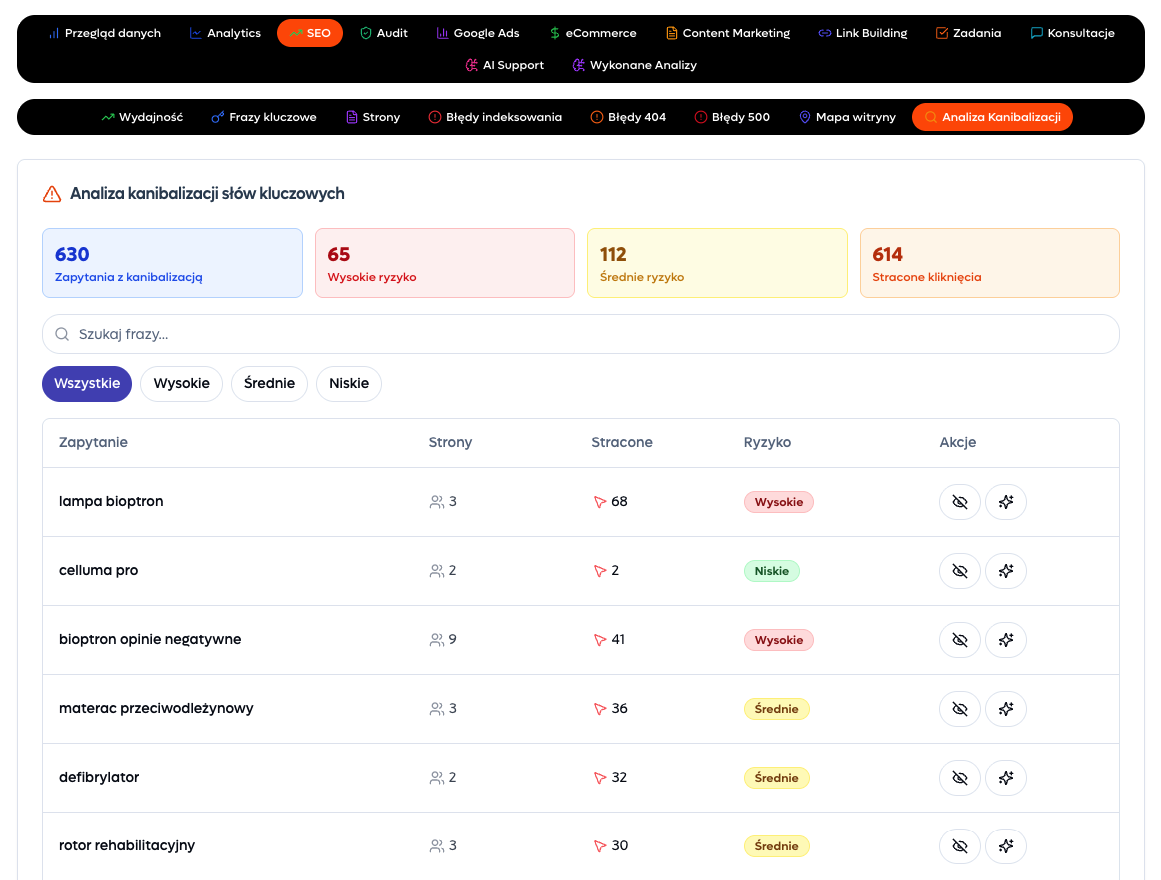
Remediation strategies: A discussion of 5 effective methods to combat cannibalization
Once the problem of cannibalization has been diagnosed, the key is to implement an appropriate remediation strategy. The choice of method depends on the specifics of the competing parties, their merits and business goals. There is no one-size-fits-all solution, but there are several proven techniques to effectively resolve internal competition. The most important thing is to approach the problem strategically, choosing a method that not only eliminates cannibalization, but also strengthens your site's overall SEO signal and improves the user experience.
Content consolidation: How do you combine cannibalizing pages into one strong resource?
Content consolidation is one of the most effective methods of combating cannibalization. It involves combining several weaker, competing articles into one comprehensive and exhaustive piece of content. The process begins with the selection of one main URL, which will become the new "home" for the combined content. The most valuable sections from the other articles should then be transferred to this main one, creating material that is far superior to the sum of its parts. After publishing the updated content, redirect the remaining, no longer needed URLs using a 301 redirect to the main one. This way you consolidate not only the content, but also all the authority (link equity) in one place.
301 redirects: When and how to use them to redirect traffic from cannibalized sites?
A 301 redirect is a permanent redirect that informs browsers and search engine robots that a page has permanently changed its address. In the context of cannibalization, this is ideal when one site is clearly weaker, outdated or less valuable than the other. Rather than removing the weaker site, which would cause it to lose its potential authority from backlinks, you set up a 301 redirect on it to the address of the stronger site. This transfers all the traffic and SEO power from the weaker site to the targeted one, strengthening its position and definitely eliminating the problem of cannibalization for that pair of URLs.
How to optimize internal linking to avoid keyword cannibalization?
Internal linking is a powerful signal to Google, helping it understand the structure of your site and the hierarchy of importance of individual pages. If you have diagnosed cannibalization, conduct an internal link audit. Make sure that links with anchor text containing the cannibalized keyword phrase consistently lead to the single most important page of your choice. Remove or change links leading to competing pages. By doing so, you send a clear signal to Google: "this particular page is my main resource on this topic." Proper internal link management helps the search engine properly evaluate and rank your content.
How to plan a content strategy to avoid cannibalization in the future?
The best way to combat cannibalization is to prevent it from occurring. By proactively planning your content strategy, you can avoid creating competing content and build strong, consistent thematic authority. The key is to take a strategic approach to each new article that takes into account already existing resources on the site. Rather than acting haphazardly, it's worth creating a system that ensures that each new publication complements, rather than undermines, the value of the material created so far. This is an investment in long-term and stable organic visibility growth.
Conduct a step-by-step audit of existing content for keyword cannibalization.
A regular content audit is the foundation for preventing cannibalization. Start by creating a spreadsheet with all the URLs and the primary keywords assigned to them. You can use tools like Ahrefs, SEMrush or Google Search Console data for this. Then sort the list by keywords and look for duplicates. Pay special attention to phrases with multiple URLs attached to them. Such an audit not only identifies existing problems, but also gives you a full picture of your site's topic coverage, which is invaluable for planning new content and avoiding duplicate topics in the future.
Create content map: visualize page structure and links between articles to minimize cannibalization.
A content map, also known as a keyword map, is a strategy document that assigns specific key phrases and topics to specific URLs on your site. Before you write a new article, check the map to see if that topic has already been assigned to another page. A content map helps you stay organized and ensures that each page has a unique role and purpose. It allows you to plan your content development in a hierarchical way, creating topic clusters where one main article (pillar page) is supported by more detailed, linking sub-pages. This structure is readable by Google and minimizes the risk of cannibalization.
Optimize content for specific keywords: avoid over-saturation and focus on user intent.
When creating new content, focus on precise alignment with one main key phrase and the intent behind it. Instead of creating two similar articles, consider whether you can combine different aspects of the topic into one comprehensive piece of content. Instead of a "how to fix a faucet" and "leaky kitchen faucet" article, create one comprehensive "How to fix a leaky kitchen faucet: a step-by-step guide." Use synonyms and thematically related phrases to naturally expand the context, rather than repeating the same phrase over and over again. Focusing on user intent allows you to create content that is unique and valuable, rather than simply duplicating existing information.

In working with semguru, we have noticed a difference in their approach to our business. We especially appreciate their deep understanding of the specifics of our business and customization of comprehensive SEO activities. We value the assurance that the budget invested is allocated to specific, measurable activities. We were surprised by their professional attitude and commitment to scaling our business online, treating it with the same priority as ourselves. The quality and effectiveness of our marketing efforts has visibly increased, and every penny spent translates into increased revenue. With semguru, we are confident that we are investing in key elements for the growth of our business.
Michal Nowak
ranomed.com.pl
What are the benefits of SEO without cannibalization? Key benefits for business
Solving the problem of cannibalization is not just technical optimization for search engines. It's a strategic action that brings tangible business benefits. What comes from positioning a site free of internal competition is, first of all, stable growth, better conversion and more efficient use of the marketing budget. Clean and logical content structure translates into trust on the part of both algorithms and users, which is the foundation for a sustainable competitive advantage on the Internet and maximizing the return on investment in SEO.
How does SEO without cannibalization translate into higher page rank in search results?
When you eliminate cannibalization, you consolidate all ranking signals into one strongest site. Instead of two sites vying for position 15, you have one that has a real chance of reaching the TOP 5. Concentrating authority from backlinks, topical relevance and user engagement in one place sends an extremely strong signal to Google. The search engine no longer doubts which site is the best answer to a user's query, which it rewards with a higher and, more importantly, more stable position in search results. This directly translates into increased visibility and more organic traffic.
Improving conversion rates: Why does a well-optimized site without cannibalization generate more leads and sales?
Cannibalization often leads to a situation where Google promotes a page that is not optimized for conversion. This could be an old blog post without a call to action (CTA), instead of a polished offer page. By eliminating cannibalization, you gain control over which page ranks. You can deliberately promote a URL that is designed to drive users down the sales funnel. By directing traffic to the most converting page, you directly impact the number of inquiries, leads and sales generated, making your SEO efforts yield much better business results.
Strengthening domain authority: How does SEO without cannibalization build your site's credibility in the eyes of Google?
A cannibalization-free site has a clear and logical information architecture. It sends a signal to Google that you are an expert in your field who thoughtfully organizes knowledge. Each page has a clearly defined place and purpose, which builds the thematic authority of the entire domain. Users, coming across comprehensive and well-organized content, are more likely to share and link to it, which generates natural backlinks. Long-term, such a strategy builds your brand as a trusted source of information in the industry, which is one of the most valuable assets that can be built through SEO.

Przemysław Przybylski - CEO of Semguru
Semguru founder and strategist with 15+ years of experience in digital marketing. Drives the company's growth and sets direction for the entire teamDiscover more on our blog

How to Measure SEO Results? Rankings and Traffic Aren't Enough—What Matters Are Sales and Profitability
October 12, 2026The year 2026 is forcing a shift in the approach to evaluating marketing efforts. Marketing directors are moving away from simply tracking search engine rankings and toward analyzing the actual impact of organic traffic on company revenue.
Read More
How to Choose an SEO Agency? 10 Questions to Ask Before Signing a Contract
October 5, 2026Today's market demands precise business decisions. The right SEO agency determines your company's online visibility. Understanding the current realities helps you avoid financial losses.
Read More
Is Your Company Wasting Its Marketing Budget? 8 Signs That SEO and Google Ads Are Working in Isolation Instead of Together
September 28, 2026A lack of collaboration between marketing departments results in huge financial losses. Your company is missing out on opportunities to dominate search results.
Read More
How to Prepare Your Online Store for Black Friday 2026
September 14, 2026An early start determines November sales figures. The competition isn't waiting until fall.
Read More
How much does website SEO cost in 2026, and what factors determine the price of SEO?
September 7, 2026Marketing budgets have undergone drastic changes this year due to new technological realities. Understanding these mechanisms allows companies to plan their spending in a way that protects them from losing visibility.
Read More
SEO or Google Ads in 2026: Which Will Boost E-Commerce Sales Faster?
August 31, 2026The year 2026 brings a new reality for marketing directors managing online stores. Decisions regarding budget allocation require a thorough understanding of the specific characteristics of both traffic acquisition channels.
Read More